As an organic learner I find a lot of my intuitive understanding being tied down with those in the know....
Mafia Island
"Islam
who taught the mafia".......When Roger of Sicily defeated it's Islamic
(and Jewish) rulers, he forcibly converted them to Catholicism. Many
secretly continued their old ways. |The word "MAFIA" is Arabic, it means
"our place in the shade" (our secret place) The Italian mobs have
always been Islamic in origin.
Liberal DECEPTION
Shuck and Jive has been the tactic of the GhettoCrats for over 50 years....
 |
| Being taken for a ride by those who DRIVE "for" them. |
Grew up watching spoiled white kids gravitate to "tough" blacks
The Genesis of Shuck and Jive....
 |
| The Chicago Way who learned from Alinsky, who learned from the Mafia who learned from Islam |
see their word for DECEIT -Islam: Taqiyya
 |
| The End JUSTIFIES the Means |
From their the Italian MAFIA picked up on it....

Omerta-code of silence
from there...
Alinsky picked up on it from his alliance with the Mafia and transferred it to "community organizers
Finally, we will consider what accounts for these many similarities
between Islam and the mafia, including from an historical perspective.
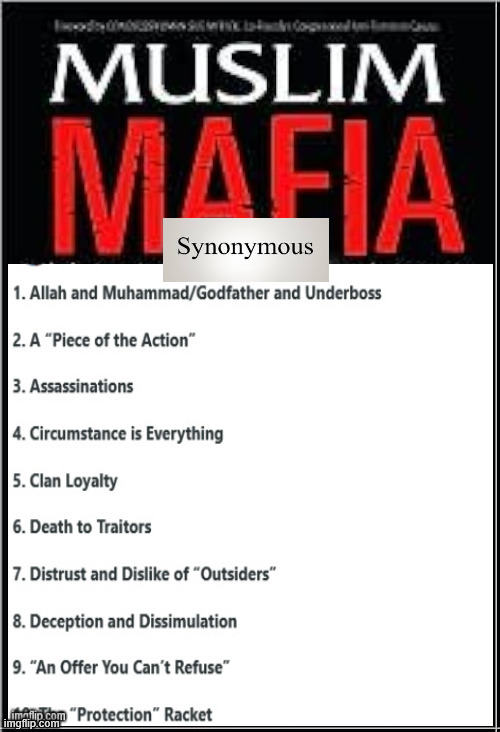
1. Allah and Muhammad/Godfather and Underboss
The padrino of larger mafia organizations and
families—literally, the “godfather” or “boss of bosses”—has absolute
control over his subordinates and is often greatly feared by them for
his ruthlessness. He has an “underboss,” a right-hand man who issues
his orders and enforces his will. The godfather himself is often
inaccessible; mafia members need to go through the underboss or other
high ranking associates.
Compare this with the relationship between Allah and his “messenger”
Muhammad (in Arabic, Muhammad is most commonly referred to as al-rasul,
“the messenger”). Unlike the Judeo-Christian God—a personal God, a
Father, that according to Christ is to be communed with directly (Matt
6:9)—Islam’s god, Allah, is unreachable, unknowable, untouchable. Like
the godfather, he is inaccessible. His orders are revealed by his
messenger, Muhammad.
If the Judeo-Christian God calls on the faithful to “come now, let us
reason together” (Isaiah 1:18), Allah says “Do not ask questions about
things that, if made known to you, would only pain you” (Koran 5:101).
Just follow orders.
2. A “Piece of the Action”
The godfather and his underboss always get a “piece of the action”—a “cut”—of all spoils acquired by their subordinates.
So do Allah and his messenger, Muhammad. Koran 8:41 informs Muslims
that “one-fifth of all war-booty you acquire goes to Allah and the
messenger” (followed by Muhammad’s family and finally the needy).
3. Assassinations
The godfather, through his underboss, regularly sends mafia men to
make “hits”—to assassinate—those deemed enemies of the family.
So did Allah and his messenger. One example: A non-Muslim poet, Ka‘b ibn Ashraf,
insulted Muhammad, prompting the latter to exclaim, “Who will kill this
man who has hurt Allah and his messenger?” A young Muslim named Ibn
Maslama volunteered on condition that to get close enough to assassinate
Ka‘b he be allowed to lie to the poet.
Allah’s messenger agreed.
Ibn Maslama traveled to Ka‘b and began to denigrate Islam and Muhammad
until his disaffection became so convincing that the poet took him into
his confidence. Soon thereafter, Ibn Maslama appeared with another
Muslim and, while Ka‘b’s guard was down, slaughtered the poet, bringing
his head to Muhammad to the usual triumphant cries of “Allahu Akbar!”
4. Circumstance is Everything
While the mafia adheres to a general code of conduct, the godfather issues more fluid orders according to circumstances.
This is reminiscent of the entire “revelation” of the Koran, where
later verses/commands contradict earlier verses/commands, depending on
circumstances (known in Islamic jurisprudence as al-nāsikh wal-mansūkh, or the doctrine of abrogation).
Thus, whereas Allah supposedly told the prophet that “there is no compulsion in religion” (Koran 2:256), once the messenger grew strong enough, Allah issued new revelations calling for all-out war/jihad till Islam became supreme (Koran 8:39, 9:5, 9:29, etc.).
While other religions and scriptures may have contradictions, only
Islam rationalizes them through abrogation—that is, by giving prominence
to later verses which are seen as the “latest” decision of the deity.
5. Clan Loyalty
Loyalty is fundamental in the mafia. Following elaborate rituals of
blood oaths, mafia members are expected to maintain absolute loyalty to
the family, on pain of death.
Similarly, mafia members are expected always to be available for the family—“even if your wife is about to give birth,” as one of the mafia’s “ten commandments” puts it—and to defend the godfather and his honor, even if it costs their lives.
Compare this to the widespread violence and upheavals that occur
whenever Allah or his prophet is offended—whenever non-Muslim “infidels”
blaspheme them. Or, as Bill Maher put it: “Its’ the only religion that
acts like the mafia, that will f***ing kill you if you say the wrong
thing, draw the wrong picture, or write the wrong book.”
Islam’s “Loyalty and Enmity” doctrine (al-wala’ wa’l bara’)—which
calls on Muslims to be loyal to one another even if they dislike each
other—is especially illustrative. Koran 9:71 declares that “The
believing [Muslim] men and believing [Muslim] women are allies of one
another” (see also 8:72-75). And according to Muhammad,
“A Muslim is the brother of a Muslim. He neither oppresses him nor
humiliates him nor looks down upon him…. All things of a Muslim are
inviolable for his brother in faith: his blood, his wealth, and his
honor”—precisely those three things that mafia members respect among
each other. This is why Muslims like U.S. Army Major Nidal Hassan,
whose “worst nightmare” was to be deployed to fight fellow Muslims, often lash out.)
6. Death to Traitors
Once a fledging mafia member takes the oath of loyalty to the
mafia—including the Omertà code of silence and secrecy—trying to leave
the “family” is seen as a betrayal and punishable by death. Any family
member, great or small, is given authority to kill the traitor, the
“turncoat.”
Compare this to Islam. To be born to a Muslim father immediately
makes the newborn a Muslim—there are no oaths to be taken, much less any
choice in the matter. And, according to Islamic law, if born Muslims
at any point in their lives choose to leave Islam, they are deemed
“apostates”—traitors—and punished including by death. Any zealous
Muslim, not just the authorities, is justified in killing the apostate
(hence why Muslim families that kill apostate children are rarely if
ever prosecuted).
In the words of Muhammad—the messenger (“underboss”) of Allah (“godfather”): “Whoever leaves his Islamic faith, kill him.”
7. Distrust and Dislike of “Outsiders”
Aside from loyalty to the family, mafia members are also expected not
to befriend or freely associate with “outsiders”—who by nature are not
to be trusted, as they are not of the “family”—unless such a
“friendship” helps advance the family’s position.
Similarly, the second half of the doctrine of Loyalty and Enmity—the enmity (al-bara’)—calls on Muslims to maintain distance from and bear enmity for all non-Muslims, or “infidels.”
Thus Koran 5:51 warns Muslims against “taking the Jews and Christians
as friends and allies … whoever among you takes them for friends and
allies, he is surely one of them.” According to the mainstream Islamic
exegesis of al-Tabari, Koran 5:51 means that the Muslim who “allies with
them [non-Muslims] and enables them against the believers, that same
one is a member of their faith and community,” that is, a defector, an
apostate, an enemy.
Similar scriptures include Koran 4:89, 5:54, 6:40, 9:23, and 58:22;
the latter simply states that true Muslims do not befriend
non-Muslims—“even if they be their fathers, sons, brothers, or kin.”
Koran 60:1 declares, “O you who believe! Do not take my enemy and your
enemy [non-believers] for friends: would you offer them love while they
deny what has come to you of the truth [i.e., while they deny Islam]?”
And Koran 4:144 declares “O you who believe! Do not take the infidels as
allies instead of the believers. Do you wish to give Allah
[“godfather”] a clear case against yourselves?”
8. Deception and Dissimulation
As mentioned, close relations to non-mafia individuals that prove
advantageous to the family (for example, collaboration with a “crooked
cop”) are permissible—as long as the mafia keeps a safe distance, keeps
the outsider at arm’s length.
Compare this to Koran 3:28 which commands “believers not to take
infidels for friends and allies instead of believers… unless you but
guard yourselves against them, taking precautions.” According to the
standard Koran commentary of Tabari, “taking precautions” means:
If you [Muslims] are under their [non-Muslims’]
authority, fearing for yourselves, behave loyally to them with your
tongue while harboring inner animosity for them … [but know that] Allah
has forbidden believers from being friendly or on intimate terms with
the infidels rather than other believers—except when infidels are above
them [in authority]. Should that be the case, let them act friendly towards them while preserving their religion.
After interpreting Koran 3:28 as meaning that Muslims may “protect”
themselves “through outward show” when under non-Muslim authority, Ibn
Kathir, perhaps Islam’s most celebrated exegete, quotes Islam’s prophet
(“underboss”) saying: “Truly, we smile to the faces of some people,
while our hearts curse them.”
Similarly, a few years ago, Sheikh Muhammad Hassan—a leading Salafi cleric in Egypt—
asserted on live television
that, while Muslims should never smile to the faces of non-Muslims,
they should smile, however insincerely, if so doing helps empower Islam,
especially in the context of
da‘wa.
The idea of hating “outsiders” is apparently so ingrained in Islam
that another leading Salafi cleric, Dr. Yasser al-Burhami, insists that,
while Muslim men may marry Christian and Jewish women,
they must hate them in their heart—and show them that they hate them in the hopes that they convert to the “family” of Islam.
(For more on the doctrine of “Loyalty and Enmity,” including
references to the exegetical sources quoted above, see al-Qaeda leader
Dr. Ayman Zawahiri’s comprehensive treatise by that name in
The Al Qaeda Reader, pgs. 63-115.)
9. “An Offer You Can’t Refuse”
Although the novel-turned-movie,
The Godfather, is fictitious, it also captures much of the mafia’s modus operandi. Consider, for example, that most famous of lines—“
I’m going to make him an offer he can’t refuse”—spoken
by the Godfather to one of his “godsons,” an aspiring actor and
singer. After being turned down by a studio director for a role that he
desperately wanted, the godson turned to his Godfather for aid.
As the movie progresses, it becomes clear that the offer that can’t
be refused consists of nothing less than violence and death threats:
after the Godfather’s messenger to the director asking that the actor be
given the role is again rejected, the director awakens the next morning
to find the bloodied and decapitated head of his favorite stallion in
bed with him. The godson subsequently gets the movie role.
Throughout the context of the entire
Godfather trilogy
(which captures well the mafia’s approach to business) making someone
“an offer they can’t refuse” means “do as I say or suffer the
consequences,” possibly death.
Compare this to Islam’s threefold choice. On Muhammad’s
orders,
whenever Muslims conquer a territory in the name of Islam, its
non-Muslim inhabitants are given three choices: 1) convert to Islam
(“join the family”), 2) keep your religious identity but pay tribute (
jizya, see below) and live as an “outsider,” a subjugated
dhimmi or 3) execution.
Throughout history, converting to Islam has been an “offer” that
countless non-Muslims could not refuse. In fact, this “offer” is
responsible for transforming much of the Middle East and North Africa,
which were Christian-majority in the 7
th century when the jihad burst forth from Arabia, into the “Muslim world.”
And this
offer is still alive and well today.
For example, several older and disabled Christians who were not able to
join the exodus out of Islamic State controlled territories
opted to convert to Islam rather than die.
Like the mafia, then, Islam’s offer to conquered non-Muslims
(“outsiders”) is basically “join our ‘family,’ help us and we will help
you; refuse and we hurt you.”
10. The “Protection” Racket
Once the mafia takes over a territory, one of the primary ways it
profits is by collecting “protection money” from its inhabitants. While
the protection racket has several aspects, one in particular is akin to
an Islamic practice: coercing people in the mafia’s territory to pay
money for “protection,” ostensibly against outside elements; in fact,
the protection bought is from the mafia itself—that is, extortion money,
or
pizzo.
Potential “clients” who refuse to pay for the mafia’s “protection”
often have their property vandalized and are routinely threatened and
harassed.
Compare the collection of
pizzo with the Islamic concept of
jizya: The word
jizya
appears in Koran 9:29: “Fight those among the People of the Book
[Christians and Jews] who do not believe in Allah nor the Last Day, nor
forbid what Allah and his Messenger have forbidden, nor embrace the
religion of truth,
until they pay the jizya with willing submission and feel themselves subdued (emphasis added).”
In the
hadith, the Messenger of Allah, Muhammad—in our analogy, the “underboss”—regularly calls on Muslims to demand
jizya from non-Muslims: “If they refuse to accept Islam,” said the prophet, “demand from them the
jizya. If they agree to pay, accept it from them and hold off your hands. If they refuse to pay
jizya, seek Allah’s help and fight them.”
The root meaning of the Arabic word “jizya” is simply to “repay” or
“recompense,” basically to “compensate” for something. According to
the
Hans Wehr Dictionary, the standard Arabic-English dictionary,
jizya is something that “takes the place” of something else, or “serves instead.”
Simply put, conquered non-Muslims were to
purchase their lives,
which were otherwise forfeit to their Muslim conquerors, with money.
As one medieval jurist succinctly puts it, “their lives and their
possessions are only protected by reason of payment of
jizya” (
Crucified Again, p. 22).
And to top it off, just as the mafia rationalizes its collection of
“protection money” by portraying it as money that buys mafia protection
against “outsiders”—when, as mentioned, the money/tribute serves only to
protect the client from the mafia itself—so too do
Islam’s apologists portray the collection of jizya as money meant to buy Muslim protection from outsiders, when in fact the money/jizya buys protection from Muslims themselves.
Conclusion: Mafia—What’s In a Word?
What accounts for all these similarities between Islam and the mafia? One clue is found in the fact that the very word “mafia,”
which means “hostility to the law, boldness,” is derived from an Arabic word,
mahya, which in translation means “bragging, boasting, bravado, and swaggering.”
This etymology is a reminder that Sicily, birthplace of the mafia,
was under Arab/Islamic domination for over 200 years. Aside from a
borrowed etymology, could some of the mafia’s modus operandi also have
been borrowed from Islam? Isolated on their island, could native
Sicilians have co-opted the techniques of social controls that they had
lived under and learned from their former overlords—albeit without their
Islamic veneer?
The mafia is not the only historical example of a non-Muslim criminal
organization to be influenced by Islam. For example, the Thuggees —
whence we get the word “thug” — were a brotherhood of allied bandits and
assassins who waylaid and savagely murdered travelers in India, often
by first feigning friendship. Although they were later associated with
the Hindu cult of Kali, the original Thuggees were all Muslim. As late
as the 19
th century, a large number of Thuggees captured and convicted by the British were Muslim.
The similarities are clear: Along with assassinating his opponents,
including, as seen, through treachery, Muhammad also personally engaged
in banditry, ransacking the caravans of enemy tribes.
And if the words “mafia” and “thug” have Arabic/Islamic etymologies,
the words “assassinate” and “assassin” are derived from a Medieval
Islamic sect: the
Hashashin, who pioneered the use of political assassination—with
promises of a hedonistic paradise for the assassin who almost certainly died—in the name of Islam.
At any rate, when HBO personality Bill Maher recently proclaimed that
Islam is “the only religion that acts like the mafia, that will f***ing
kill you if you say the wrong thing, draw the wrong picture, or write
the wrong book,” he was barely touching on the similarities between the
mafia and other criminal organizations, and Islam.
From their THE ghettoCrats picked up the false narrative of
WHITE GUILT to manipulate further..




 Omerta-code of silence


